
You’ve done the hard work of getting ClickHouse into production. The dashboards that used to make people wait are fast. Adoption is growing. More teams want access to the data.
Then someone sends you a message: Why doesn’t the inventory dashboard match the order system?
You check the query. It ran exactly as expected. ClickHouse is healthy. The latest transactions are still waiting upstream for the next batch. You solved the query-performance problem, but people still question the answer because the data behind it hasn’t caught up.
So how do you bring more operational data into ClickHouse without putting additional pressure on the systems running your business? How do you move from scheduled extracts to continuous data without creating another fragile pipeline your team has to babysit?
That’s the problem Striim and ClickHouse are solving together.
Striim’s ClickHouse connector gives enterprises a continuous path from operational systems such as Oracle, SQL Server, and Snowflake into ClickHouse. Striim captures changes as they happen, prepares them for analytical use, and delivers them into ClickHouse for high-performance analytics, observability, applications, and AI.
Once the queries are fast, the pipeline gets the scrutiny
Operational databases are busy doing what they were designed to do: processing orders, payments, shipments, account updates, and all the other transactions your applications depend on.
That makes them a difficult place to run increasingly frequent analytical extracts. You can shorten a batch interval from one day to one hour, or from one hour to five minutes. But each change means more jobs to schedule, monitor, and recover. It can also mean more work for the production database.
Striim takes a different approach. It uses log-based change data capture to read committed inserts, updates, and deletes from database transaction logs. For example, Striim’s Oracle connector reads Oracle redo logs instead of repeatedly scanning production tables. The result is a continuous stream of changes from the source.
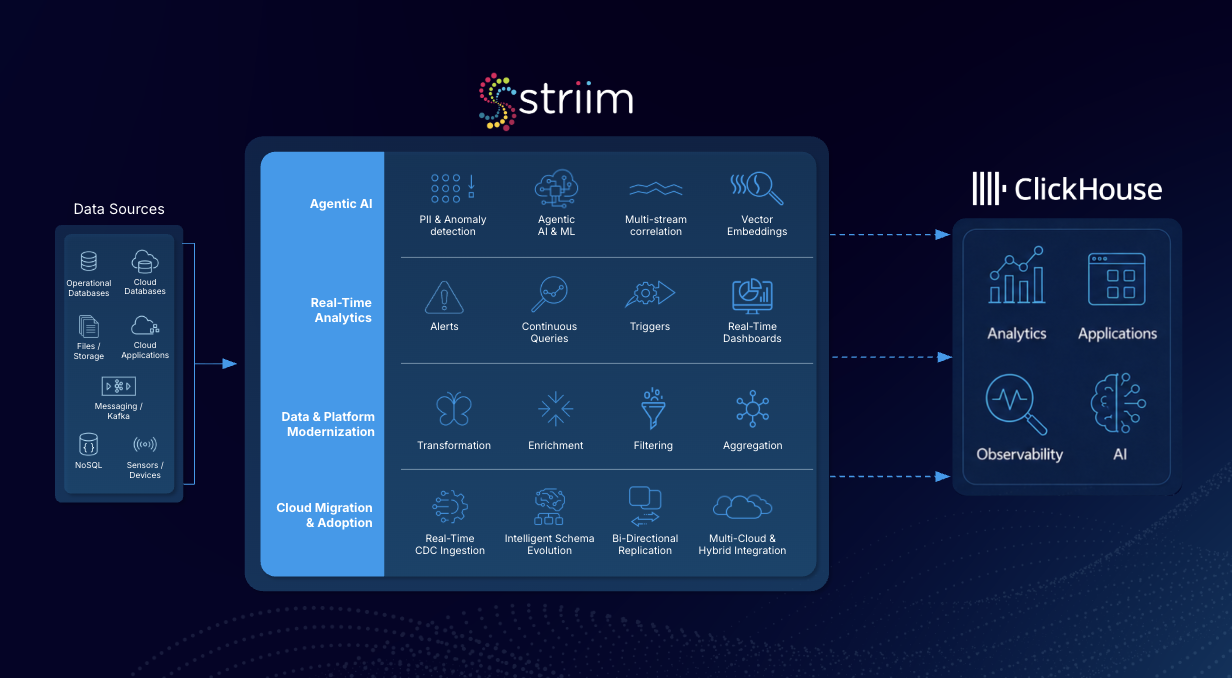
Of course, you also need everything that happened before the stream began. Striim supports an initial load of the existing dataset and then continues with CDC from the corresponding position in the source log. Your team can establish the starting state in ClickHouse and transition into continuous replication without leaving a gap between the two.
Moving changes is only part of the job
Now the data is moving. But what happens when an order is updated, a customer record is corrected, or a transaction is deleted?
Striim’s ClickHouse Writer carries all changes into ClickHouse according to how you want the target to behave.
If you need a history of every change, `Append Only` mode writes each operation as a new row. If you need ClickHouse to reflect the current source state, `Merge` mode applies inserts, updates, and deletes to the target.
The right approach depends on what you plan to query later: the sequence of changes, the latest state of each record, or both.
You also need to choose the ClickHouse table engine that matches your CDC pattern. Striim supports MergeTree, ReplacingMergeTree, CollapsingMergeTree, and CoalescingMergeTree configurations. Each handles mutable records differently, so you can align the source row image with the update and query behavior you need in ClickHouse.
Then there’s the data itself. Does it need to be restructured before it lands? Are there fields you don’t want exposed downstream? Do different teams need different versions of the same event?
Striim can filter, route, transform, enrich, mask, or encrypt the data while it’s moving. You can capture a source change once, apply your processing and governance rules, and send the result to one or more ClickHouse tables.
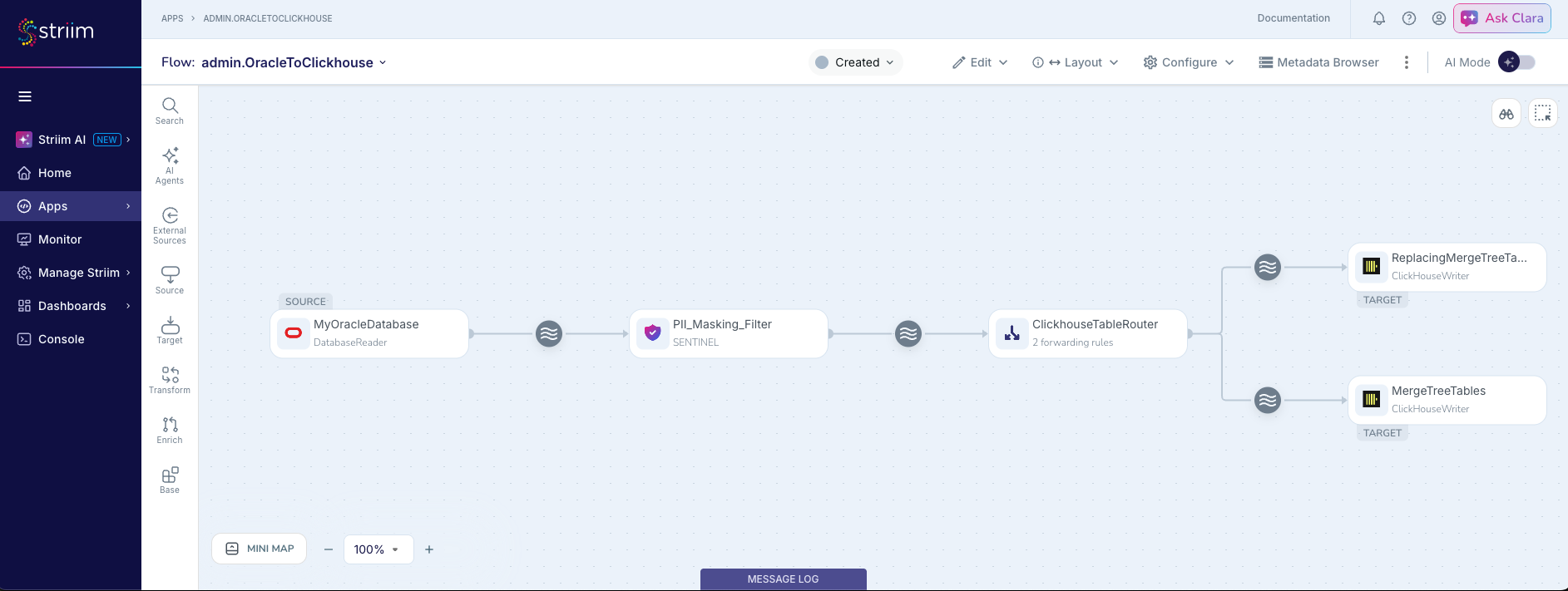
Once the events are ready, Striim batches them locally as CSV and sends them directly into ClickHouse through the ClickHouse JDBC V2 client. There’s no intermediate cloud staging layer in the write path.
What works in a POC needs to hold up in production
However, a pipeline that works against a few tables at a steady rate can behave very differently in a large production environment.
What happens during your busiest processing window? What happens when a source team adds a column without telling you? How does the pipeline resume after a maintenance window or network interruption?
Parallel writes and scale-out allow Striim’s ClickHouse integration to increase throughput as source volumes grow. Flexible table and column mappings give you control over how source structures appear in ClickHouse.
Supported schema evolution allows compatible DDL changes to move from the source to the target without rebuilding the pipeline for every update. Configurable recovery semantics allow pipelines to easily recover from interruptions with a single click.
These capabilities are what make the difference once the connector moves beyond a proof of concept. Your team gets a pipeline designed to adapt to the normal changes, failures, and volume shifts that come with running enterprise data infrastructure.
Once you have that production path in place, you can start using it for more than the dashboard that prompted the project.
One source stream can support more of the business
Think about how many teams care about the same order update. Fulfillment needs it to manage inventory. Customer support needs it to answer questions. Finance needs it for revenue reporting. Fraud teams need it to evaluate risk.
Do you really want each team building its own connection to the order database?
Striim can capture the event once, process and protect it in motion, and route it into ClickHouse tables designed for different workloads. Your central data team can manage the source connection, CDC, governance, and reliability while domain teams use the representation they need.
That same operational data also becomes available to AI applications. An inventory agent can check the latest available stock level before confirming an order. A customer-facing agent can include recent account activity in its response. A fraud application can evaluate a new transaction alongside the history already stored in ClickHouse. Through the ClickHouse MCP server, compatible agents can query data in ClickHouse and explore its schema.
Make more of the business available in ClickHouse
ClickHouse provides the speed and scale to analyze massive amounts of data across analytics and AI. Striim keeps that data flowing from the operational systems where it’s constantly being created and changed.
So when something changes in the business, the data available in ClickHouse changes with it, giving analytics and AI a current view of what’s actually happening.
If your analytics and AI are ready to move in real time, your data should be too.
Try Striim’s ClickHouse connector and see how quickly you can start streaming live operational data from Oracle, SQL Server, and other sources into ClickHouse for real-time analytics and AI.